
News Briefing · Netherlands · Civil Liberties
GayJustice Says Hundreds Signed WorldPride Petition Seeking Independent Review of Police Misconduct Allegations
August 12, 2026 · Amsterdam
An LGBTQ+ rights platform says hundreds of people signed a petition during WorldPride Amsterdam 2026 calling for independent scrutiny of allegations involving police intimidation and discrimination.
GayJustice.org, an Amsterdam-based platform focused on LGBTQ+ rights and institutional accountability, says two volunteers collected hundreds of signatures during approximately six hours of campaigning at Pride. The organisation has published photographs of its campaign and signature sheets on its website. The precise number of signatures has not been independently verified for this article. (GayJustice.org)
The petition asks for what GayJustice describes as an independent investigation and legal remedy in connection with allegations of discriminatory treatment, intimidation and other misconduct involving members of the Dutch police and, in some of its published dossiers, questions concerning the Public Prosecution Service in Amsterdam. The organisation publishes personal and family testimonies but itself acknowledges that allegations in those dossiers do not amount to judicial findings and may not have been independently established. (GayJustice.org)
According to GayJustice, visitors who stopped at its Pride campaign also spoke about experiences of discrimination, reluctance to file complaints and distrust of public institutions. Those accounts have not been independently documented by this publication and should therefore be treated as reports from the campaign organisers rather than established findings.
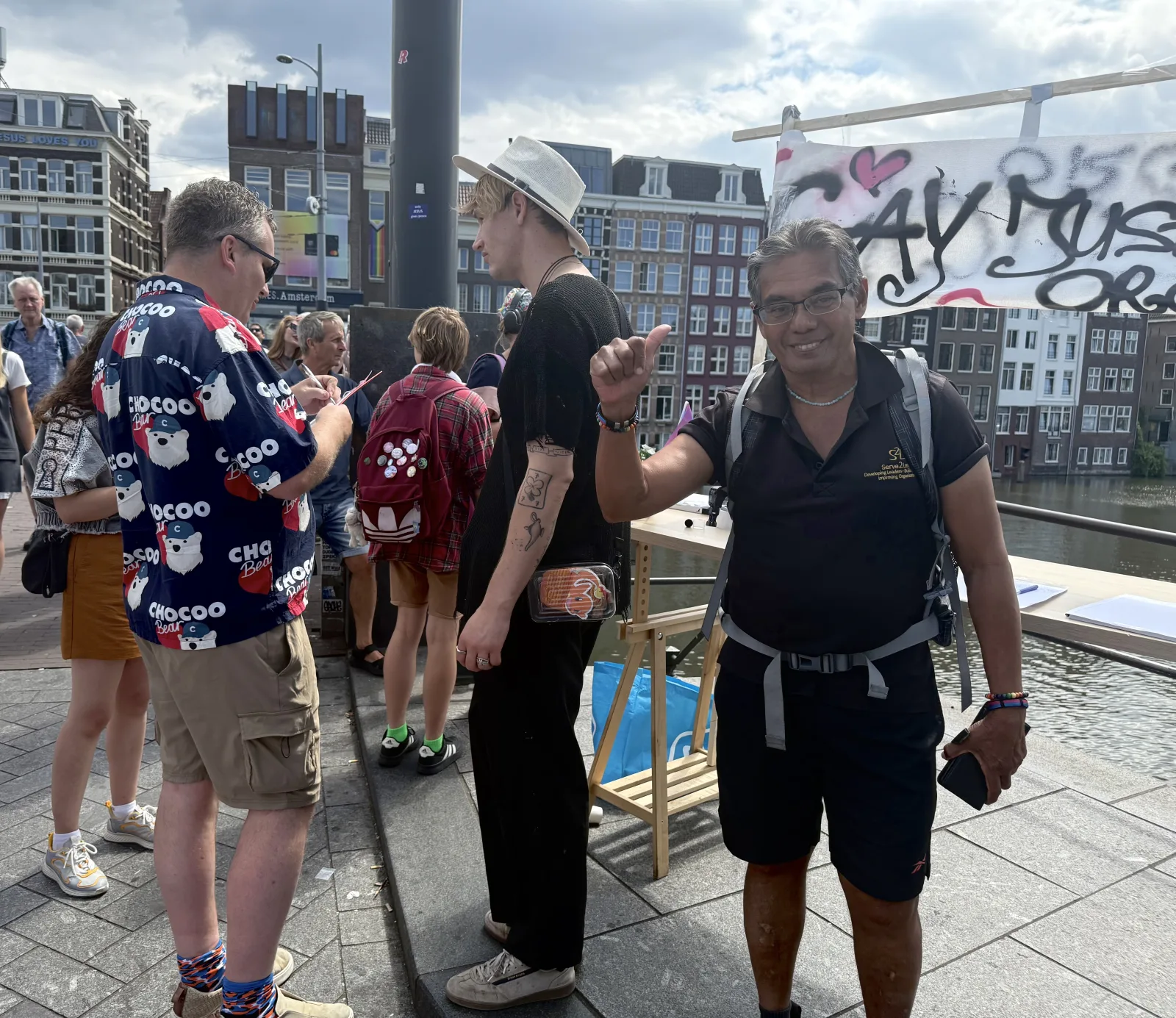
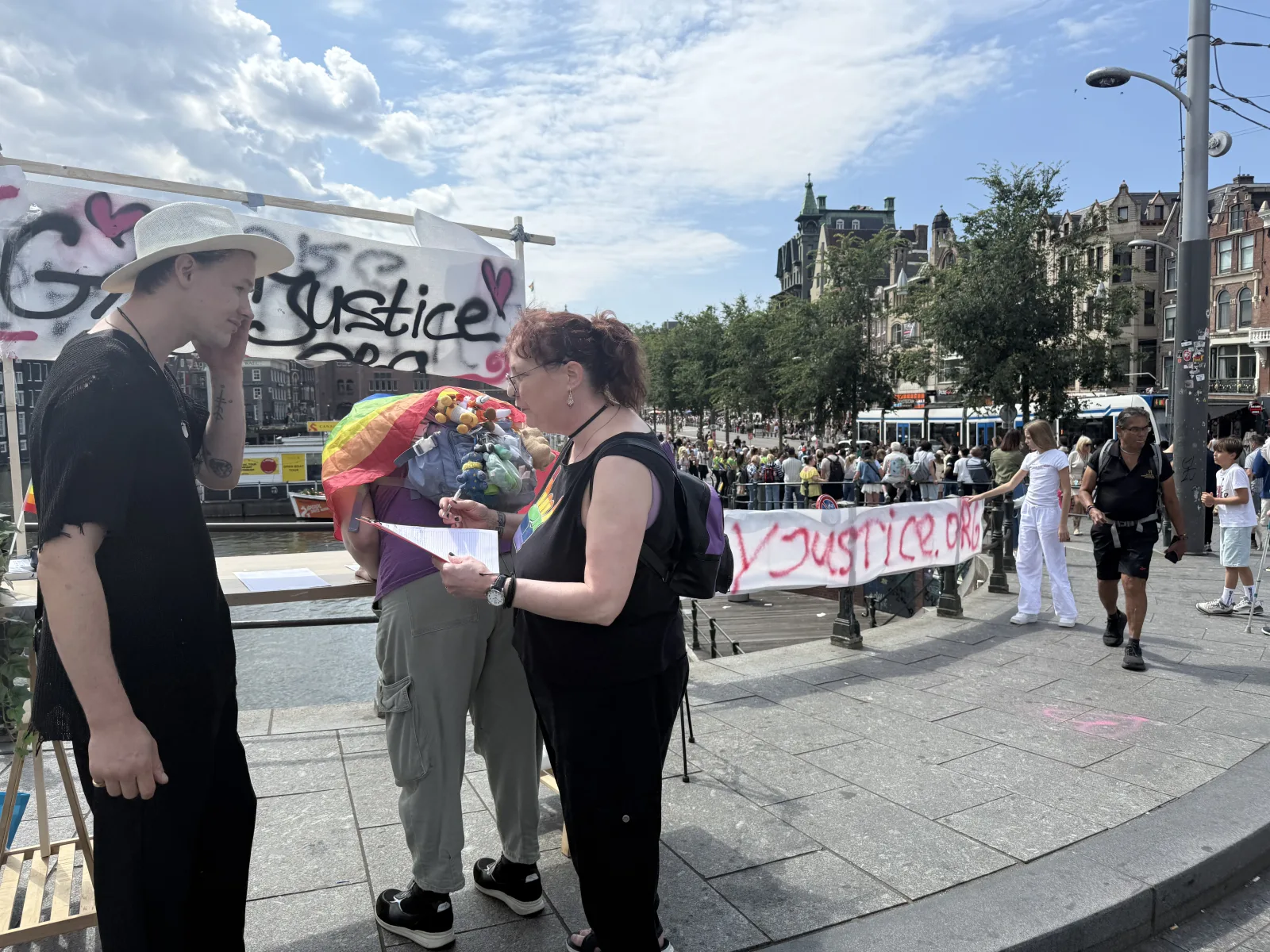
Pride campaign takes place amid wider debate over safety
WorldPride Amsterdam 2026 ran from July 25 through August 8 and combined public celebration with programming focused on LGBTQIA+ rights and international human-rights issues. Pride Amsterdam describes WorldPride as an event intended to increase visibility and awareness of LGBTQIA+ issues worldwide. (WorldPride Amsterdam 2026)
The police were also visibly involved in WorldPride. Dutch National Police participated in the event and publicly encouraged people who experience discrimination, threats or violence because of their sexual orientation or gender identity to report those incidents. The police also pointed members of the LGBTQIA+ community to its Roze in Blauw network for support. (WorldPride Amsterdam 2026)
NL Times reported that, ahead of WorldPride, Amsterdam police chief Peter Holla urged LGBTQIA+ people experiencing intimidation or violence to report incidents, while acknowledging that victims can be reluctant to approach police. The report said he argued that reports are necessary for police to identify problems and take action. (NL Times)
That position provides an important counterpoint to GayJustice’s campaign. While GayJustice argues that allegations involving police themselves may require scrutiny outside ordinary internal procedures, police authorities continue to encourage people to use existing reporting and complaint mechanisms.
Existing routes for complaints and independent scrutiny
Dutch law and administrative practice already provide several routes for complaints concerning public authorities.
A person who is dissatisfied with police conduct can file a complaint with the police. Government guidance states that complaints can be submitted digitally, verbally or in writing and normally must be filed within one year of the incident. (Government of the Netherlands)
Complaints about government bodies can also reach the National Ombudsman after the relevant complaint process. The Ombudsman examines the conduct of public authorities and has a role in monitoring whether government bodies respect citizens’ rights. (Nationale ombudsman)
For suspected serious criminal offences committed by government officials, the Rijksrecherche occupies a separate position within the Dutch justice system. It describes itself as an independent investigative department responsible in particular for serious criminal allegations involving officials including police officers and employees of the Public Prosecution Service. (rijksrecherche.nl)
Those mechanisms do not by themselves establish that the allegations promoted by GayJustice are true, nor do they determine whether a new investigation is warranted. That assessment would depend on the evidence in each case and the authority legally competent to examine it.
Campaign’s claims remain to be tested
GayJustice says the response it received during Pride demonstrates public support for greater transparency and independent oversight where police misconduct is alleged. Its campaign materials describe the signatures as backing an independent investigation into police intimidation and discrimination affecting gay and other LGBTQ+ people. (GayJustice.org)
The petition result is evidence that people chose to support the wording presented to them; it is not evidence that the underlying misconduct allegations have been proven.
Likewise, individual testimonies published by GayJustice can raise questions requiring examination, but testimony alone does not establish institutional wrongdoing. GayJustice’s own editorial material makes that distinction, describing some of its publications as personal accounts, family testimony, allegations or unresolved matters rather than established legal findings. (GayJustice.org)
A search of publicly available material reviewed for this article did not identify a specific response from the Dutch police, the Amsterdam Public Prosecution Service or the National Ombudsman to this particular GayJustice signature campaign as of August 12, 2026. That does not establish that no communication has taken place outside publicly indexed sources.
From campaign to accountability
The next significant question is therefore not simply how many people signed, but what happens to the petition and the allegations behind it.
If GayJustice submits the signatures and supporting documentation to an oversight, prosecutorial or political body, an independent publication should follow that process separately: what evidence is submitted, which authority receives it, whether that authority considers itself competent, what response the police or Public Prosecution Service provides, and whether any allegations are substantiated, rejected or remain unresolved.
That distinction is important. A campaign can itself be newsworthy without a publication adopting the campaign’s conclusions.
WorldPride Amsterdam 2026 provided GayJustice with a highly visible setting in which to make its case. Whether its allegations ultimately justify further formal investigation is a separate question—one that should be determined through evidence, applicable law and independent scrutiny rather than advocacy claims alone.
Reporting & Provenance
This briefing was independently researched and written by HeadlinesMagazine.com. The campaign source (GayJustice.org) was treated as a participant in the story, not as its narrator: signature counts are attributed rather than adopted as independently proven, the police and institutional perspective is included, and existing oversight mechanisms (National Ombudsman, Rijksrecherche) are described rather than implied to be absent.
Reporting by: Sasha Schumacher. Article type: News Briefing. Editorial review: August 12, 2026.
Material facts were checked against authoritative records where available. Claims that could not be independently verified are attributed to published accounts or to the campaign organisers.
Editorial Method
HeadlinesMagazine.com reviews public records, institutional material and published reporting during its research process.
Material facts, dates, legal developments and institutional claims are checked against authoritative records where available. Campaign claims are reported as claims; they are not adopted as established findings without independent verification.
Last editorial review: August 12, 2026.